How to Choose the Best Smart Tennis Ball Machine for Beginners in 2026
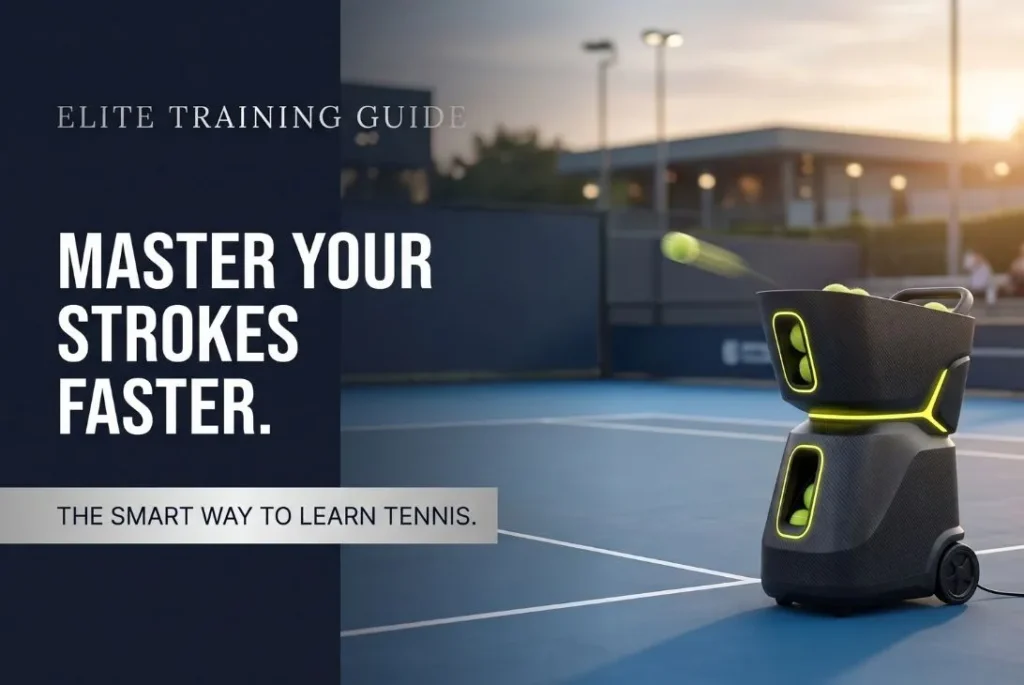
Learning tennis requires building clean muscle memory through consistent, repeatable swing paths. For recreational novices and adult learners picking up a racquet for the first time, erratic practice rallies with inexperienced hitting partners often lead to bad swing mechanics and early frustration. Selecting the best smart tennis ball machine for beginners bridges this gap by delivering accurate, rhythm-focused feeds that accelerate stroke development without the high hourly cost of private coaching.
Modern coaching methodologies emphasize structured ball delivery to establish early fundamental confidence. According to player progression frameworks established by the United States Professional Tennis Association (USPTA), novice players develop proper kinetic chain mechanics significantly faster when receiving predictable, waist-height feeds at low-to-moderate speeds before advancing to complex multi-directional footwork. By leveraging smart mobile app control and customizable drill routines, smart launchers turn solo court sessions into guided training workouts.
What Beginner Players Should Look for in a Smart Ball Machine
Novice tennis players need an entirely different feature set than advanced tournament players. Heavy kick serves and high-speed spin drills will overwhelm beginners; instead, equipment should prioritize ease of transport, wide speed adjustability, and intuitive app interfaces.
- Low Minimum Feed Speed: Machines must calibrate down to low velocities (12–15 mph / 20 km/h) with generous feed intervals (up to 8 seconds) so new players have ample time to recover, reset their stance, and complete their follow-through.
- Intuitive Smartphone and Watch Integration: Complex analog control panels with confusing manual dials make adjustments tedious. Smart Bluetooth connectivity allows players to pause feeds, adjust height, and alter trajectories directly from an app or smartwatch while standing at the opposite baseline.
- Portability and Compact Storage: Heavy, bulky equipment often ends up gathering dust in a garage. Lightweight builds (under 35 lbs) equipped with extendable luggage handles and smooth-rolling wheels ensure easy loading into compact car trunks.
- Beginner-Friendly Drill Presets: Built-in foundational modes—such as fixed deep-center feeds, gentle short lobs, and basic two-line forehand-to-backhand patterns—allow learners to train essential footwork without manual programming.
2026 Beginner Smart Ball Machine Comparison
| Model | Speed Range | Control Method | Drill Customization | Battery Life | Total Weight | MSRP / Starting Price |
| PUSUN PT-Smart Pro | 12–75 mph (20–120 km/h) | App, Apple Watch, Remote | 28 Custom Landing Points | 4–6 Hours (External LiFePO4) | 33 lbs (15 kg) | $1,398 |
| Spinshot Lite | 10–60 mph (16–96 km/h) | Manual Panel / Basic Remote | Single Fixed-Point | 2–3 Hours (Lead-Acid) | 42 lbs (19 kg) | $749–$850 |
| Lobster Elite Liberty | 10–70 mph (16–112 km/h) | Manual Control Panel | Random Horizontal Sweep | 2–4 Hours (Lead-Acid) | 35 lbs (16 kg) | $1,079–$1,179 |
| Slinger Bag | 10–45 mph (16–73 km/h) | Basic Handheld Remote | Fixed Single Trajectory | 3–3.5 Hours (Lithium) | 33 lbs (15 kg) | $749 |
Disclaimer: Specifications and prices may vary by configuration, retailer, and current availability. Always check the official product page before purchasing.
Detailed Evaluation: The Best Beginner Tennis Ball Machines on the Market
1. PUSUN PT-Smart Pro — The Ultimate Smart Learning Platform
When looking for the modern benchmark in smart court technology, PUSUN offers the most complete ecosystem for foundational learning and progressive skill development. The PUSUN PT-Smart Pro strikes an ideal balance for novice hitters, delivering high-end programmable intelligence at an approachable price point.
- Wide Dynamic Speed Range (12–75 mph): Starts low enough for children and beginners to groove basic contact points, yet reaches speeds that accommodate intermediate development as skills advance.
- Triple Smart Control Ecosystem: Control shot elevation, feed rates (1.8s to 8.0s), and directional angles via iOS, Android, Apple Watch, or the included handheld remote without walking across the net.
- 28-Point Custom Target Array: Beyond its one-tap beginner modes, the PT-Smart Pro allows users to map custom landing points across the court to gradually introduce lateral footwork drills.
- External Modular Lithium Battery: The lightweight 4–6 hour lithium battery pack unclips easily for indoor charging, eliminating the need to haul the entire machine inside after practice.
- US Fulfillment and Reliability: Backed by 20+ nationwide US warehouses for 1-3 business day delivery, supported by a 3-year warranty and a California service center.
2. Spinshot Lite — The Basic Analog Alternative
The Spinshot Lite is designed specifically for junior players and beginner adults looking for low-speed consistency. It features a compact body and simple mechanical controls. However, it lacks out-of-the-box smart control integration, tops out at 60 mph, and utilizes a heavier internal lead-acid battery with shorter overall runtimes.
3. Lobster Elite Liberty — The Traditional Club Style
The Lobster Elite Liberty provides reliable ball delivery with manual mechanical dials controlling speed, spin, and feed rates. While mechanically durable, making mid-session drill adjustments requires walking up to the baseline console repeatedly, and it lacks programmable custom multi-shot routines.
4. Slinger Bag — The Entry-Level Roller Bag
The Slinger Bag features a luggage-style roller design that appeals to casual weekend players. While portable and budget-friendly, it relies on fixed mechanical oscillation, enforces a permanent heavy topspin on all feeds, and lacks flat-ball feeding modes essential for beginners learning pure groundstroke contact.
Progressive Drills for Rapid Skill Acquisition
Maximizing practice time requires structuring sessions around targeted muscle memory drills rather than random hitting:
Static Contact Point Groove Drill
Set the launcher to a fixed center-court feed at 22 mph with a 5-second interval. This generous spacing allows beginners to practice unit turns, early racquet take-back, and consistent follow-through without worrying about complex footwork or heavy ball spin.
Fundamental Forehand-Backhand Two-Line Drill
Utilize the dual-line training mode to alternate feeds between the forehand and backhand wings at moderate intervals (4 to 5 seconds). This sequence trains players to split-step on launch, perform efficient cross-court recovery steps, and maintain balance through stroke completion.
Mid-Court Transition & Short Ball Put-Away
Program a deep baseline ball followed immediately by a short, floating feed near the service line. According to youth and adult instruction guidelines published by the International Tennis Federation (ITF), training transition footwork early builds essential spatial awareness and prevents players from getting trapped on the baseline.
Practical Maintenance and Storage Considerations
- Battery Chemistry Selection: Avoid legacy sealed lead-acid (SLA) batteries that suffer from severe memory degradation if left uncharged. Lithium (LiFePO4) systems provide higher charge retention and significantly longer cycle lives.
- Using Consistent Tennis Balls: Mixing old, dead tennis balls with fresh pressurized balls leads to uneven trajectories and erratic feeding heights. Beginners should train with dedicated pressureless training balls for uniform bounce consistency.
- Weather Protection: Ball launchers should never be operated in wet or damp conditions, as moist ball felt can cause internal drive wheels to slip and degrade feeding accuracy.
Modern On-Court Smart Technology in Action
Seeing a smart launcher in practice helps clarify how wireless drill adjustments and portable setups streamline training. For a visual demonstration of how modern, ultra-compact launchers operate across varying court positions and angles, watch the PUSUN PT Mini Pro overview to see quick app integration and automated multi-angle feeds in real time.
Investing in the best smart tennis ball machine for beginners eliminates the guesswork from foundational tennis practice. By selecting a platform like the PT-Smart Pro that combines low-speed precision, intuitive mobile control, and scalable multi-point drill capabilities, new players gain a reliable training partner that accelerates their development from first swing to tournament play.
Frequently Asked Questions (FAQs)
Why should beginners invest in a smart ball machine over a basic mechanical unit?
Smart ball machines allow beginners to adjust ball speed, height, and frequency directly from their smartphone or smartwatch. This removes the frustration of constantly walking across the court to twist manual knobs between drills.
What is the ideal feed interval for a beginner tennis player?
Beginners should use a feed interval between 4.0 and 7.0 seconds. This provides adequate time to complete the stroke follow-through, recover to the center baseline, split-step, and prepare for the next shot.
Can smart tennis ball machines run on both tennis and padel courts?
Yes. Multi-sport smart machines like the PT-Smart Pro feature adaptable trajectory angles and speed ranges that work seamlessly on both standard tennis courts and enclosed padel courts.
How often should the ball machine battery be charged?
Lithium battery packs should be recharged after every two to three practice sessions, or every 14 to 21 days during periods of storage, to maintain optimal cell health.
Is professional assembly required for smart ball machines?
No. Modern smart launchers arrive virtually fully assembled. Users simply unfold the ball hopper, attach the charged battery pack, connect to the mobile app via Bluetooth, and start practicing.